
100% Full-Load High-Temperature Aging on Every Unit
Every unit runs full-load high-temperature aging on 10 racks before packing — no sampling. 99%+ pass rate, 0.03% field failure rate.
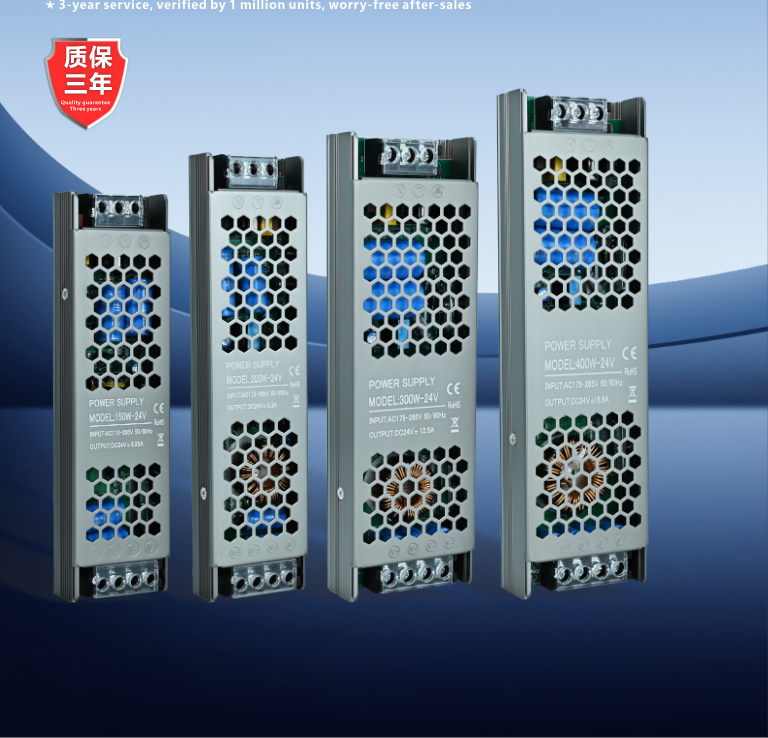
Full-load aging means every finished LED driver runs at its rated power at elevated temperature for a fixed burn-in period before packing — not a sample, every unit. Towe operates 10 aging test racks fed by 3 automated production lines, holding a production pass rate above 99% and a field failure rate at or below 0.03% across millions of shipped units.
When this process applies
Aging catches infant mortality: marginal electrolytic capacitors, cold solder joints and transformer faults that would fail in the first months on a ceiling. It does not catch design errors or long-term wear-out — those are covered by design review and life-derating rules.
Technical specifications
| Coverage | 100% of units — no sampling plan |
|---|---|
| Aging racks | 10 racks, high-temperature full load |
| Production lines | 3 automated lines feeding the racks |
| Pass rate | Above 99% at final QC |
| Field failure rate | ≤ 0.03% |
| Verified volume | 5,000,000+ units (TF fleet) |
| In-circuit test | Computerized ICT before assembly |
| Insulation test | Hipot on every waterproof unit |
Where it is the right choice
- Projects where a failed driver means reopening a facade or ceiling
- Wholesale programmes where warranty claims cost more than the test
- Export markets with unstable mains that stress marginal units
- Any buyer who wants the failure statistics in writing
Where it is the wrong choice
Stating this explicitly matters more than a capability list: if your part falls into one of these categories, another process will cost you less.
- Buyers shopping purely on the lowest unit price — 100% aging is a real cost we do not hide
- Prototype quantities of one or two pieces, where engineering review matters more than burn-in statistics
Equipment
- 10 full-load high-temperature aging racks
- Computerized ICT in-circuit test stations on each line
- Hipot insulation testers for waterproof series
- Automatic wave soldering machines (3 lines)
Process questions
Why age 100% of units instead of a sample?
Because a driver is cheap but the electrician who has to reopen a light box is not. Sampling statistics let infant-mortality failures reach customers; 100% aging catches them in our plant, and our 0.03% field failure rate is the result.
What does the aging test actually catch?
Marginal electrolytic capacitors, cold or voided solder joints, transformer winding faults and unstable switching components — the failure modes that appear in the first 1,000 hours of service. Units that survive full-load burn-in overwhelmingly stay stable afterwards.
Can you share failure statistics for my order?
Yes. Final QC pass rates are recorded per batch, and we can provide the aggregate field failure rate for the series you are buying. Ask sales for the quality summary with your quotation.
Does aging shorten the life of the driver?
No. Burn-in runs within the component derating window at rated load — it consumes the first hours of a designed 30,000+ hour service life and removes the units that would not have lasted a year.
Related capabilities and products
Automated SMT & Wave Soldering
Towe assembles LED driver boards on 3 automated production lines using SMT placement for surface-mount components and automatic wave soldering for through-hole parts such as transformers and terminals. Every board then passes computerized ICT in-circuit testing that verifies component values, polarity and shorts before the unit is ever powered..
View capabilityIP67 Potting & Sealing
Potting seals a driver’s electronics in silicone so water, dust and humidity cannot reach live components. Towe runs full-potting and semi-potting lines serving waterproof drivers from 7 W to 2000 W in aluminium housings with integrated cable glands, achieving IP67 on outdoor families with 3 to 5 year warranties..
View capabilityKnowledge Base
Tolerance tables, cost mechanics and DFM rules written for buyers rather than engineers.
Read articlesTell us the wattage, get a quote in 24 hours
Send the series or specification and your target quantity. You will receive a quotation with lead time, warranty terms and the quality summary for the series — no obligation, and no sales call unless you ask for one.